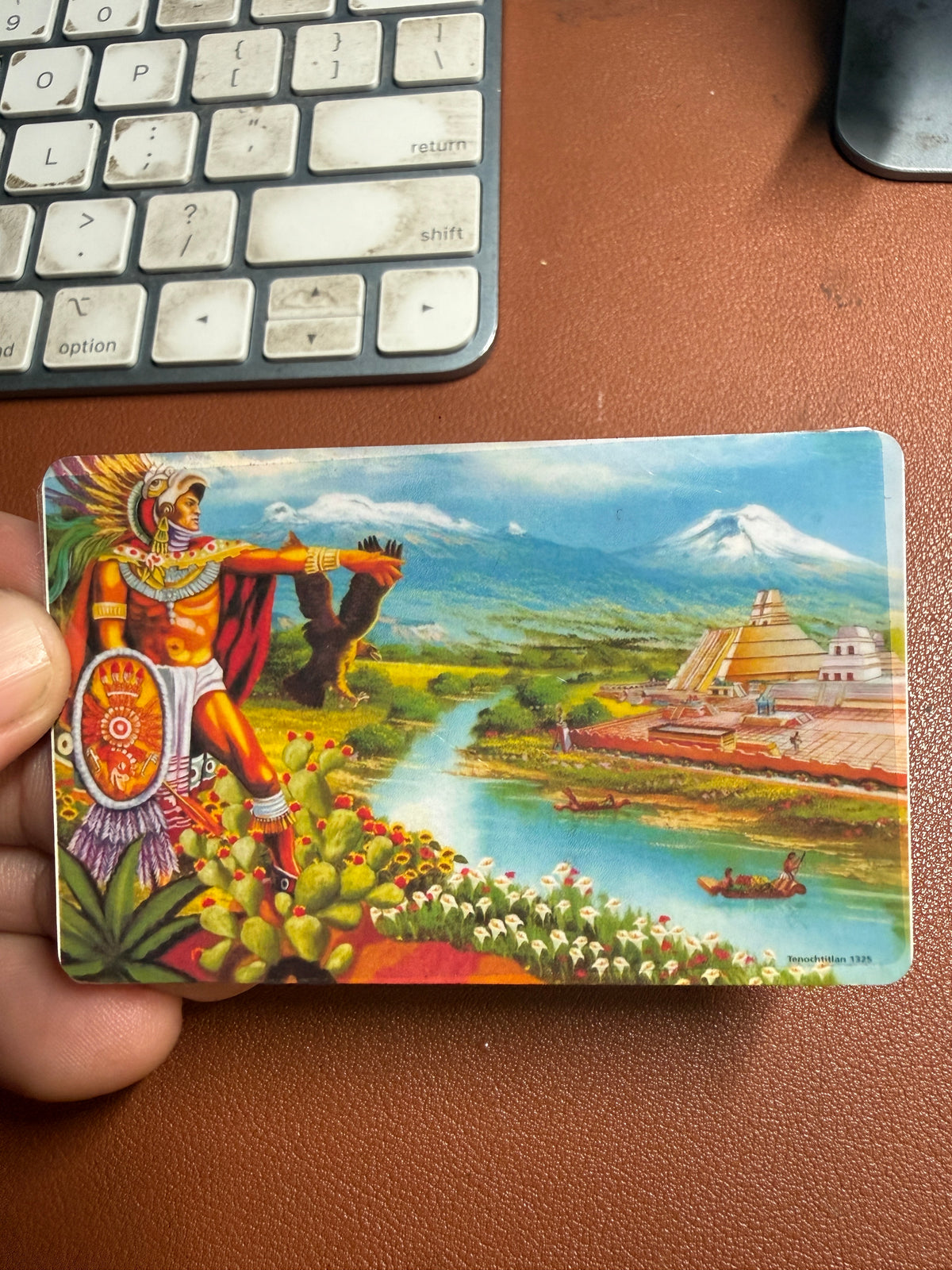
MEXICA TRIBE
MEXICA TRIBAL IDENTITY CARD, Novelty, Not A Valid Form of ID, Mexican, Mexicans, Mexico
MEXICA TRIBAL IDENTITY CARD, Novelty, Not A Valid Form of ID, Mexican, Mexicans, Mexico
Couldn't load pickup availability
MEXICA TRIBAL IDENTITY CARD, Novelty, Not A Valid Form of ID
After purchase eMail us the following:
1. Your Photo
2. Your Name you want on the card!
3. Your Date of Birth
EMAIL info to US AT MEXICATRIBECA@GMAIL.COM
DISCLAIMER: THIS CARD IS NOT TO BE USED AS A LEGAL FORM OF IDENTIFICATION.
These are “Cultural or Tribal Identity Cards”, and not a form of “Legal ID”. They cannot be used anywhere.
It is your right to love and claim the culture and tribe of you are from or lineage that has been passed down to you by your ancestors. It is your right to call yourself a name that reflects your cultural or tribal identity. There are no laws prohibiting you form practicing your culture any longer. The last time Native American culture was forbidden to practice was in the the white man first came to our land and killed indigenous people for practicing and claiming their ancestral ways. Since those days, things have changed and we are now free to be ourselves again and reclaim our identity without any threat of penalty by the European squatters.
1. Nobody has the right to force you to carry any ID.
2. It is not illegal to make a identity card under any name as long as it does not replicate a government issued one.
3. It is not a crime to change your name at will, calling yourself anything you desire, so “Fake ID” is not really fake.
4. Governments look at you as sheep and wants you tagged with their ID just as a farmer does with his cattle.
History:
The American Indian Religious Freedom Act, Public Law No. 95-341, 92 Stat. 469 (Aug. 11, 1978) (commonly abbreviated to AIRFA), codified at 42 U.S.C. § 1996, is a United States federal law, enacted by joint resolution of the Congress in 1978. Prior to the act, many aspects of various Native American religions had been prohibited by law.
It was enacted to return basic civil liberties, and to protect and preserve for American Indians their inherent right of freedom to believe, express, and exercise the traditional religious rights and cultural practices of American Indians. These rights include, but are not limited to, access to sacred sites, freedom to worship through ceremonial and traditional rites, and use and possession of objects considered sacred.
The Act required policies of all governmental agencies to eliminate interference with the free exercise of Native American religion, based on the First Amendment, and to accommodate access to and use of religious sites to the extent that the use is practicable and is consistent with an agency's essential functions. It also acknowledges the prior violation of that right.
The cultural assimilation of Native Americans was an assimilation effort by the United States to transform Native American culture to European–American culture between the years of 1790–1920. George Washington and Henry Knox were first to propose, in an American context, the cultural transformation of Native Americans. They formulated a policy to encourage the "civilizing" process. With increased waves of immigration from Europe, there was growing public support for education to encourage a standard set of cultural values and practices to be held in common by the majority of citizens. Education was viewed as the primary method in the acculturation process for minorities.
Americanization policies were based on the idea that when indigenous people learned United States (American) customs and values, they would be able to merge tribal traditions with American culture and peacefully join the majority of the society. After the end of the Indian Wars, in the late 19th and early 20th centuries, the government outlawed the practice of traditional religious ceremonies. It established Native American boarding schools which children were required to attend. In these schools they were forced to speak English, study standard subjects, attend church, and leave tribal traditions behind.
The Dawes Act of 1887, which allotted tribal lands in severalty to individuals, was seen as a way to create individual homesteads for Native Americans. Land allotments were made in exchange for Native Americans' becoming US citizens and giving up some forms of tribal self-government and institutions. It resulted in the transfer of an estimated total of 93 million acres (380,000 km2) from Native American control. Most was sold to individuals or given out free through the Homestead law, or given directly to Indians as individuals. The Indian Citizenship Act of 1924 was also part of Americanization policy; it gave full citizenship to all Indians living on reservations. The leading opponent of forced assimilation was John Collier, who directed the federal Office of Indian Affairs from 1933 to 1945, and tried to reverse many of the established policies.